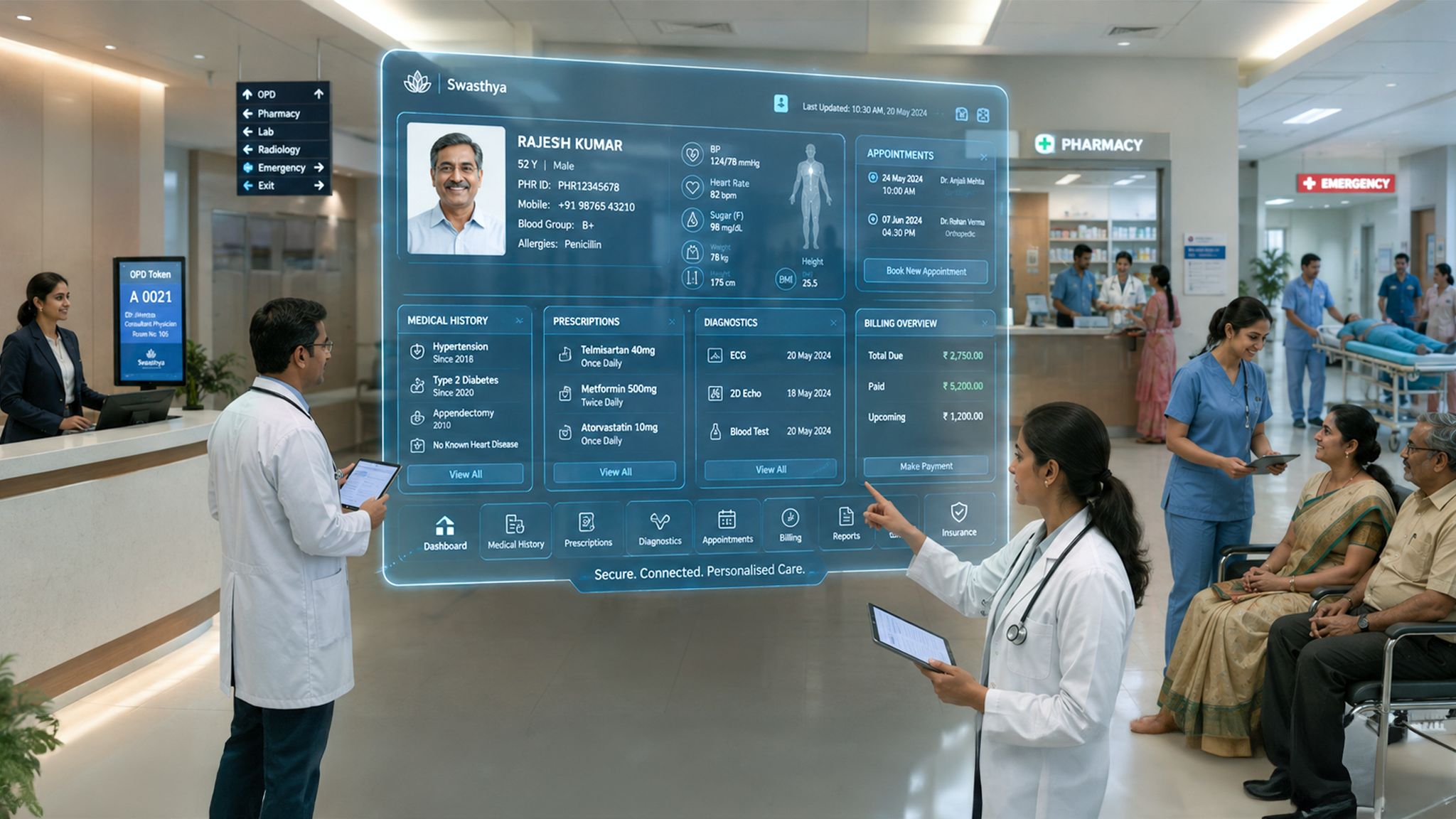
Walk into any hospital leadership meeting today and the word “AI” will come up within the first ten minutes. But dig a little deeper into those conversations and something interesting emerges. The excitement isn’t really about science fiction — it’s about something far more immediate. It’s about the orthopedic surgeon who wants clinical notes to write themselves. The CFO who wants to stop losing revenue to preventable claim denials. The operations director who wants to know a bottleneck is forming in the radiology queue before the queue actually forms.
Healthcare’s AI story, it turns out, is less about futuristic capability and more about fixing deeply practical problems that have existed for decades.
And it’s happening faster than most people realize. The share of healthcare organizations that have adopted or explored generative AI rose from 72% in early 2024 to 85% by the end of the year. According to Deloitte’s Health Care Outlook, 80% of hospitals now use AI to improve patient care and operational efficiency.
The question for hospital leaders is no longer whether to engage with AI. It’s figuring out where it actually creates value — and why it so often fails to deliver when deployed in the wrong way.
The Problem AI Alone Can’t Solve
Here’s the tension at the heart of most AI initiatives in healthcare: the technology is increasingly capable, but the environment it’s being deployed into is often deeply fragmented.
Over the past decade, most hospitals built out their digital foundations piece by piece. A Hospital Information System here, an EHR there, a separate laboratory platform, a pharmacy system that doesn’t connect to either. The result is what IT teams call “siloed data” — information that exists but can’t move freely to where it’s needed.
A patient might be registered in one platform, examined in another, have imaging ordered through a third, and receive a bill generated by a fourth system that had to manually reconcile charges from all of the above. Each system might be competent at what it does. None of them are talking to each other.
AI sits on top of this infrastructure. And the uncomfortable truth is that an algorithm can only be as good as the data it’s given access to. Access to large amounts of high-quality and granular data remains one of the most significant bottlenecks to AI-enabled clinical decision support systems.
This is why the most effective AI deployments in healthcare aren’t standalone products. They’re layers of intelligence built on top of connected, interoperable workflows. The value comes from the combination, not the algorithm in isolation.
Operations: From Firefighting to Forecasting
Ask any hospital operations director what their day looks like and the answer usually involves a lot of reactive problem-solving. A ward is suddenly understaffed because no one anticipated the admission surge. The pharmacy flagged a stock shortage after a medication had already been delayed. The billing team found coding gaps at end-of-month that should have been caught weeks ago.
Traditional hospital operations run on retrospective reporting — problems that are identified after they’ve already happened. AI fundamentally changes that dynamic.
Take staffing. Machine learning models can now analyze historical admission patterns, seasonal demand curves, and real-time occupancy data to predict when a department is likely to be overwhelmed — and trigger staffing adjustments before the surge arrives rather than during it. Scheduling optimization using machine learning algorithms predicts patient volumes and staff availability, yielding more efficient shift assignments.
Bed management is another area where predictive intelligence is showing measurable results. Stanford HealthCare achieved 31 to 40% reductions in patient wait times using predictive analytics in healthcare to level-load chemotherapy infusions. At Froedtert Health and the Medical College of Wisconsin, AI and machine learning approaches were used to optimize bed capacity and improve coordination between departments. A model trained on 1.8 million emergency department visits demonstrated 85.4% accuracy in predicting admissions — outperforming nurse predictions, which came in at 81.6% accuracy.
The broader implication is significant. AI-driven capacity forecasting allows healthcare leaders to shift from reactive management to proactive resource planning, improving both patient outcomes and operational resilience.
Inventory is another quiet beneficiary. A 2024 survey found that 90% of supply chain managers believe AI can improve forecasting, yet fewer than 30% have integrated it fully. Hospitals using AI logistics tools have reported meaningful reductions in expired inventory and supply shortages — outcomes that affect both patient safety and cost management.
A Workflow Worth Walking Through
To understand what AI-enabled operations actually look like in practice, consider a patient visiting an orthopedic clinic for knee pain. It’s a routine encounter, but it touches every corner of a hospital’s workflow.
In a traditional, disconnected environment: reception enters demographic details into one system, the physician documents clinical notes in another, imaging requests are processed through a separate platform, the pharmacy receives a prescription that may or may not include a complete medication history, and billing eventually reconciles charges — manually — from across all of those systems. Each handoff is a potential gap. Each gap is a potential delay, error, or missed charge.
Now layer in AI across a connected workflow.
Appointment demand forecasting has already adjusted staffing levels before the patient arrives. At registration, demographic data flows automatically into the consultation record. During the encounter, AI-assisted documentation reduces typing time and helps the physician capture structured data more efficiently. Imaging orders are placed electronically and tracked in real time. Medication dispensing updates inventory automatically. By the time the patient leaves, billing has already received a complete, coded record of every service rendered.
The patient experiences less waiting. The clinician spends more time on care. The finance team receives fewer reconciliation problems. And the entire encounter generates structured, connected data that can inform future decisions.
None of that is hypothetical. It describes what integrated AI-enabled systems are doing in leading hospitals today.
Clinical Decision-Making: Supporting the Clinician, Not Replacing Them
One of the most carefully watched applications of AI in healthcare is clinical decision support — tools that help clinicians make better diagnostic and treatment decisions by surfacing relevant information at the right moment.
The results from real-world deployments are beginning to accumulate. A study evaluating AI-based clinical decision support across 39,849 patient visits at a network of primary care clinics found that clinicians with access to the AI tool made 16% fewer diagnostic errors and 13% fewer treatment errors compared to those without it. In absolute terms, the introduction of the tool would avert diagnostic errors in 22,000 visits and treatment errors in 29,000 visits annually at that network alone.
It’s worth being precise about what these tools actually do. They don’t diagnose. They surface. A well-designed clinical decision support system, reviewing a diabetic patient’s records, might highlight a trend in kidney function values that warrants closer attention, flag a potential drug interaction in the current medication list, or prompt the clinician about a screening protocol that’s due based on the patient’s history. The clinician evaluates the information and makes the decision. The AI ensures that relevant information doesn’t get buried.
AI-informed clinical decision support systems show measurable improvements in diagnostic accuracy, risk stratification, resource use, and patient outcomes compared to traditional models, offering the potential to assist clinicians in managing symptom complexity and uncertainty in healthcare delivery.
The biggest practical obstacle — and it’s consistent across virtually every study of clinical AI — remains data access. A decision support system that can only see two of the five systems a patient’s history is spread across is working with an incomplete picture. Which brings the conversation back, again, to the importance of connected workflows.
Documentation: The Administrative Burden Nobody Talks About Enough
There’s a running joke among hospital clinicians that their job is documentation, with some patient care squeezed in between.
It’s not entirely a joke. Studies consistently demonstrate that physicians spend twice as much time on electronic documentation and clerical tasks as compared to time providing direct patient care. Research suggests physicians spend approximately half their workday working in EHRs, with many logging an additional 90 minutes daily on documentation outside clinic hours.
This burden carries serious downstream effects. Clinicians facing burnout are more likely to report medical errors and lower patient satisfaction. The pipeline of physicians intending to leave the profession is fed, in significant part, by administrative exhaustion.
AI-assisted documentation tools directly address this. Ambient scribing technology — where AI listens to a consultation and automatically generates structured clinical notes — is one of the fastest-growing applications in healthcare. The University of Chicago Medicine reported that 90% of 550+ clinicians using AI documentation platforms now give patients undivided attention during consultations — up from just 49% previously. Apollo Hospitals in India has announced plans to expand AI documentation tools with the goal of freeing two to three hours per day for each clinician to use for patient care or recovery from burnout.
The most rapidly increasing use case in 2023–24 was AI for billing and coding automation, with algorithms reading clinical notes to suggest appropriate billing codes and flag claim errors — a task traditionally done by coders. The improvement in documentation quality isn’t just good for clinicians. It flows directly into coding accuracy, which flows directly into revenue.
Revenue: Where Problems Start Long Before Claims Are Filed
Most hospital finance teams think of revenue cycle management as something that starts at claims submission. The industry is slowly realizing this framing is the source of much of its pain.
Healthcare denial rates have surged to 11% of all claims, costing providers $19.7 billion annually in denial management expenses — and that figure doesn’t account for delayed revenue or the strategic resources diverted to administrative firefighting. In 2025, 41% of providers reported that over 10% of their claims are denied — up from 30% in 2022.
The root cause of most denials isn’t insurer obstruction. It’s documentation problems, coding inconsistencies, missing authorizations, and charge capture gaps that originate weeks before a claim is ever filed. By the time the denial arrives, the opportunity to fix the underlying issue has long passed.
AI changes this by moving intervention upstream. Algorithms can monitor documentation completeness in real time, flag potential coding errors as encounters are being documented, identify charges that aren’t being captured, and predict which claims carry a high denial risk before they’re submitted.
The results from organizations that have done this are striking. One California healthcare network that implemented AI-powered claims review saw a 22% decrease in prior authorization denials and an 18% reduction in denials for non-covered services. A New York hospital system used AI to increase coder productivity by 40% and cut its backlog of discharged-not-final-billed cases by 50%.
Automated claim-scrubbing and predictive validation can prevent up to 85% of avoidable denials, reducing administrative cost per claim by nearly one quarter, according to the Deloitte Center for Health Solutions. Organizations that make use of modern healthcare analytics platforms in routine revenue cycle workflows report 30% higher productivity and 20% lower turnover within patient financial services.
For hospital CFOs operating in an environment where hospitals lose an average of 4.8% of net revenue to denials, these aren’t incremental improvements. They’re meaningful changes to the financial trajectory of an organization.
The Insurance Authorization Maze — And What AI Does to It
If documentation is the upstream revenue problem, insurance authorization is its downstream equivalent.
Getting prior authorization for an inpatient surgical procedure traditionally involves a team of staff coordinating across clinical departments, documentation systems, insurer portals, and finance offices — often through a combination of phone calls, faxes, and email chains. It’s time-consuming, error-prone, and extraordinarily dependent on staff capacity that most hospitals don’t have in abundance.
AI-enabled workflow automation restructures this process. Authorization requests can be generated from clinical documentation automatically, with missing information flagged before submission rather than after denial. Claims that meet historical denial patterns get flagged for preemptive review. Status tracking becomes real-time rather than periodic.
Despite the documented benefits — the majority of AI adopters report fewer denials and more successful resubmissions — only 14% of providers are currently using AI to reduce denials, suggesting that adoption is being held back by uncertainty about implementation rather than evidence about outcomes.
That gap between awareness and adoption is, in many ways, the defining story of healthcare AI right now.
What Hospital Executives Actually Need From Analytics
There’s a specific frustration that shows up consistently in conversations with healthcare executives: they know their organization generates enormous amounts of operational data, and they have almost no real-time access to it.
Reports are compiled at month-end from multiple disconnected systems. By the time leadership reviews them, the operational conditions that produced those numbers have changed. Strategic decisions are made on outdated information, and course corrections are almost always reactive.
Connected healthcare analytics software address this by pulling data from across clinical, operational, and financial systems into a single, continuously updated view. Bed occupancy in real time. Diagnostic turnaround trends by department. Pharmacy utilization patterns. Revenue cycle performance by payer. Emergency department throughput by hour.
The shift from retrospective to real-time intelligence doesn’t just improve decision speed. It changes the nature of hospital leadership. Executives can move from asking “what happened last month?” to “what’s happening right now, and what’s likely to happen next week?”
As health systems expand across multiple facilities, this kind of enterprise-wide visibility becomes particularly valuable. Performance gaps between sites become visible. Resource allocation decisions become better-informed. Governance becomes more consistent.
The Prerequisite Nobody Wants to Talk About
There’s a pattern in AI implementations that fail, and it’s consistent enough to be called a rule. The technology was deployed before the workflows were connected.
An AI-powered demand forecasting tool that can only access scheduling data from one department isn’t forecasting hospital demand — it’s forecasting that department’s demand. A clinical decision support system that can’t see the patient’s imaging history because imaging runs on a separate, unintegrated platform is making recommendations from an incomplete picture. A revenue cycle AI that only reviews claims after they’re generated misses the documentation problems that determined those claims’ accuracy weeks earlier.
The prerequisite for AI that works is data that moves. And data moves when workflows are connected.
In 2025, leading healthcare organizations are defining interoperability success not by compliance metrics, but by how well information improves care coordination, transitions, patient safety, and patient experience. The organizations that are getting the most from AI are the ones that did the less glamorous work first — aligning their systems, cleaning their data, and designing workflows where information flows to the people who need it at the moment they need it.
What Getting It Right Looks Like
Successful AI implementation in healthcare tends to share a handful of characteristics that aren’t about the technology at all.
The first is process redesign before digitization. The organizations that achieve lasting results don’t automate existing workflows. They redesign them — mapping where information flows, where it gets stuck, and what decisions require what information — and then build technology to support the redesigned process.
The second is treating implementation as a continuous effort rather than a project with an end date. The hospitals reporting the strongest gains from AI are the ones still actively optimizing months and years after go-live. The technology improves. Patient populations shift. Regulatory requirements evolve. The workflow has to evolve with them.
The third is keeping humans in the loop — not as a compliance formality, but as a design principle. 40% of U.S. physicians report being ready to use generative AI when interacting with patients at the point of care, but readiness has limits. The most durable implementations are the ones where clinical staff trust the tool because they understand what it’s doing and why — and where they retain clear authority over the decisions that matter.
The Hospitals That Will Lead the Next Decade
There’s a version of the AI conversation in healthcare that treats it as a competitive differentiation question — some hospitals will have it, some won’t, and the ones that do will pull ahead.
That framing underestimates what’s actually at stake. The hospitals and health systems that invest in connected workflows and AI-enabled operations aren’t just going to run more efficiently. They’re going to make better clinical decisions. They’re going to catch the documentation gaps that prevent correct diagnoses. They’re going to identify the patient whose deteriorating kidney function hasn’t yet crossed a threshold any individual clinician would flag, but that a model reviewing the full longitudinal record would see clearly.
Healthcare AI professionals note that slow AI implementation risks missed opportunities for early intervention, more clinician burnout from administrative overload, and a growing backlog of patients waiting for care. The long-run projection from McKinsey puts AI’s potential contribution to healthcare savings between $100 billion and $600 billion by 2050 — driven by faster diagnosis, fewer errors, and more efficient resource use.
But the near-term case is compelling enough on its own. Better-connected operations mean fewer denied claims, faster diagnoses, less documentation burden on clinicians, more accurate capacity planning, and patients who move through the system with less friction.
The intelligent hospital of the future isn’t the one with the most AI. It’s the one where AI has the best environment to work in: connected data, integrated workflows, and clinical and administrative teams who know how to use the intelligence they’re being given.
Lifetrenz brings together hospital operations, clinical workflows, revenue cycle management, and analytics into one connected digital ecosystem — giving AI the integrated data environment it needs to deliver meaningful, measurable outcomes across every department.