A connected digital backbone for hospitals and healthcare enterprises looking to scale care delivery, operations, and revenue performance without scaling complexity.
Lifetrenz Hospital unifies clinical, operational, and financial workflows into one intelligent platform, helping healthcare organizations deliver better care, improve efficiency, and gain greater operational visibility.
Clinical teams work on one system. Billing teams work on another. Diagnostics, pharmacy, operations, and finance rely on disconnected workflows.
Lifetrenz Hospital connects every major clinical, operational, and financial workflow across the hospital ecosystem.
From registration and consultation to diagnostics, inpatient care, billing, claims, and follow-up every workflow operates through one connected patient record and shared operational data layer.
Every department works from the same connected patient information in real time.
Procedures, diagnostics, pharmacy activity, consumables, and clinical documentation connect directly with billing, coding, insurance, claims, and collections workflows.
Inventory, procurement, pharmacy stock, approvals, utilization tracking, dashboards, and operational reporting work together through one connected hospital operations ecosystem.
Lifetrenz Hospital integrates compliance, audit readiness, traceability, and governance directly into operational workflows instead of treating compliance as a separate operational burden.
Cloud-native, scalable, interoperable, and designed for hospitals operating across departments, specialties, and multiple locations.
Unified operations across facilities.
One source of truth for oversight.
Seamless connectivity across systems.
Built for security, compliance, and control.
Instant insights across the enterprise.
Standardized workflows at scale.
Whether implementing across a single hospital or a multi-location healthcare network, Lifetrenz prioritizes:

A unified platform like Lifetrenz helps eliminate data silos while improving care delivery and operational efficiency.
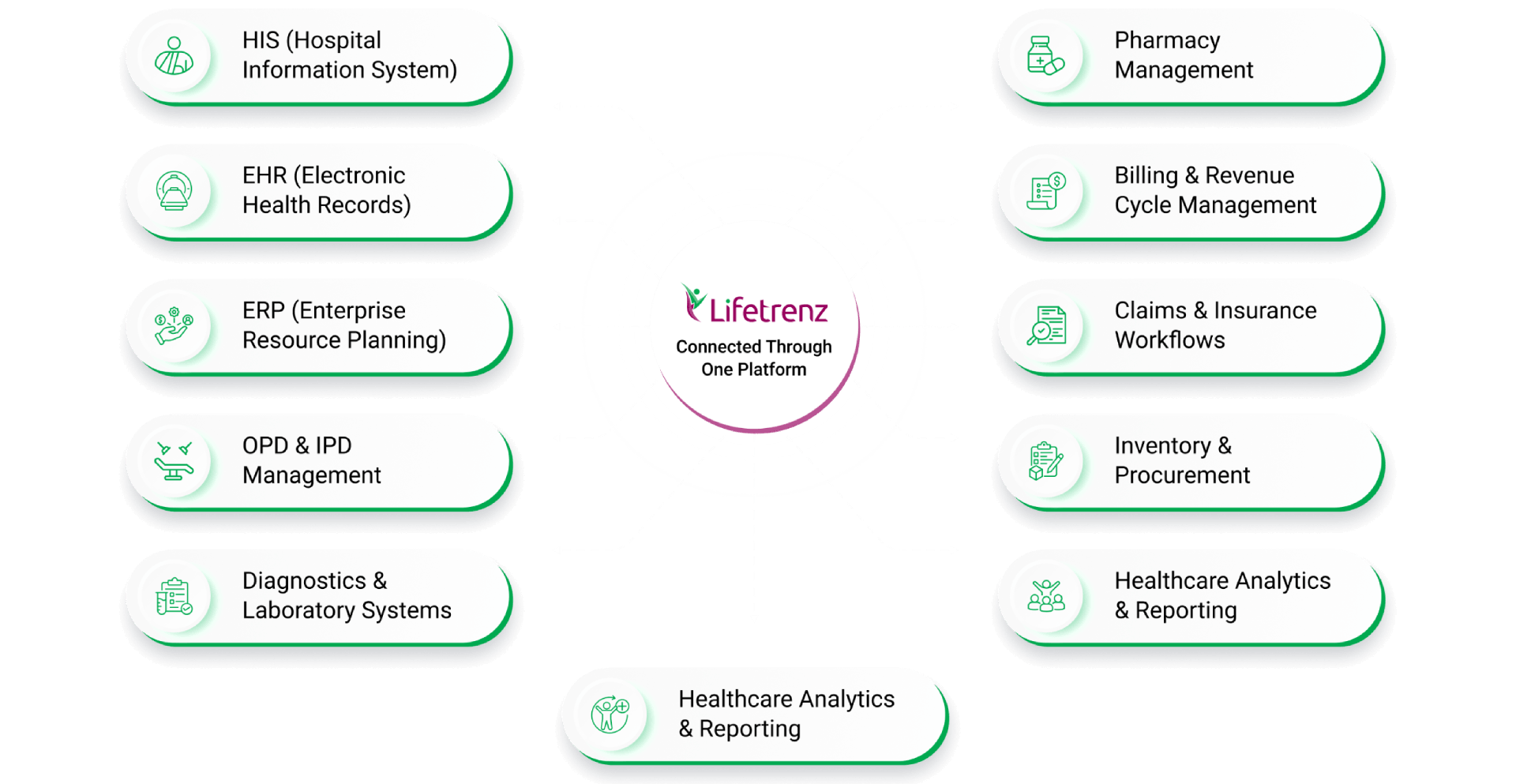
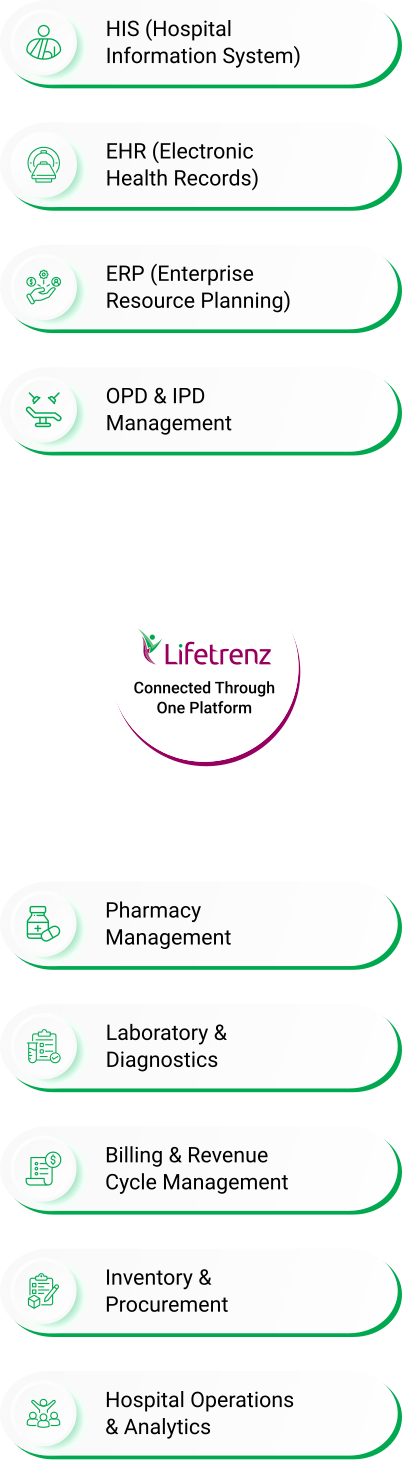
The different modules covered by Lifetrenz are:
Healthcare software enables clinicians and hospital administrators to access accurate, real-time patient and operational information. By connecting patient records, diagnostics, treatment history, and clinical workflows, healthcare organizations can improve care continuity, reduce errors, make faster decisions, and monitor operational performance more effectively.
The cost of a hospital management system depends on several factors, including hospital size, number of users, deployment model, required modules, and implementation scope. Cloud-based platforms often provide flexible subscription models that reduce upfront infrastructure costs. The right solution should be evaluated based on long-term operational value, scalability, and return on investment rather than software cost alone.
The best hospital management software should offer:
A unified platform helps eliminate data silos while improving care delivery and operational efficiency.
Lifetrenz Hospital connects every stage of the patient journey—from registration and consultation to diagnostics, inpatient care, billing, insurance, and follow-up. With shared patient information across departments, clinicians gain complete patient visibility while operational teams eliminate duplicate data entry, manual coordination, and workflow delays. The result is better care continuity, faster operations, and an improved patient experience.
Yes. Modern hospital management software like Lifetrenz Hospital is designed to integrate clinical and operational systems into a single connected platform. This includes Electronic Health Records (EHR), laboratory information systems, pharmacy management, billing, insurance, and revenue cycle workflows. Connected integrations improve data accuracy, eliminate duplicate entries, and enable seamless information flow across departments.
The terms are often used interchangeably, but there is a subtle difference. A Hospital Information System (HIS) primarily focuses on managing clinical information and hospital operations, while Hospital Management Software generally refers to the broader platform that combines clinical, administrative, financial, and operational functions. Modern healthcare platforms integrate both capabilities into one connected ecosystem that supports end-to-end hospital management.
Administrative teams spend significant time on repetitive processes such as registration, billing, insurance, reporting, and documentation. Lifetrenz Hospital automates these workflows, connects departments through shared information, and reduces duplicate data entry. This allows hospital staff to spend less time managing processes and more time supporting patient care.
Yes. Enterprise-grade hospital management software is designed to support multi-location hospitals and healthcare networks. It provides centralized governance, standardized workflows, shared patient information, consolidated reporting, and real-time operational visibility across multiple facilities while maintaining consistent processes throughout the organization.
Modern hospital management systems like Lifetrenz Hospital are built with enterprise-grade security measures to protect sensitive patient information. These typically include secure deployment environments, role-based access controls, data encryption, audit trails, regular backups, and compliance with healthcare data standards and regulations. A secure platform helps hospitals maintain patient privacy while ensuring authorized users have timely access to critical information.