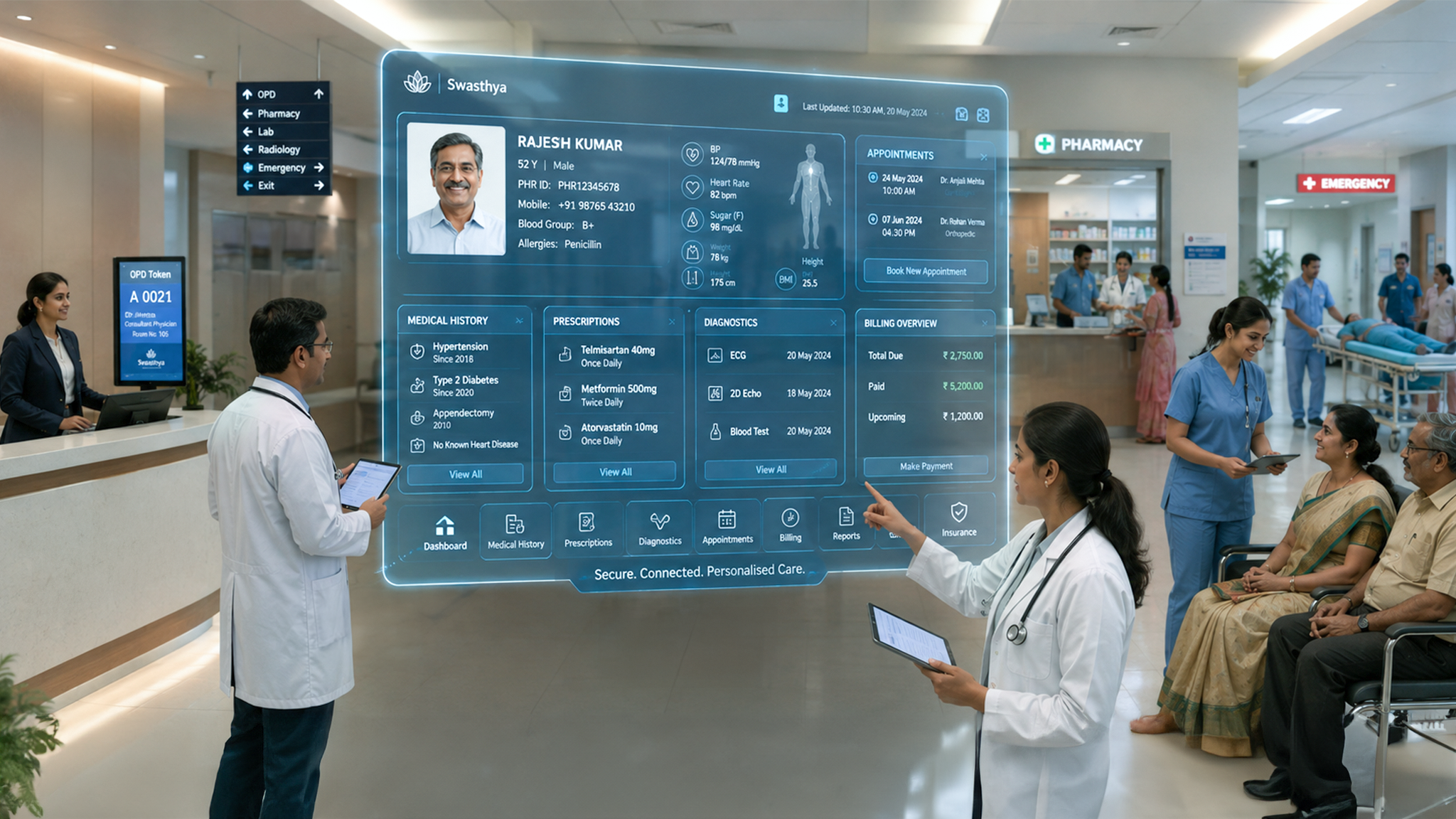
India and the UAE are both building national digital health backbones, but in opposite ways. India’s Ayushman Bharat Digital Mission (ABDM) is a consent-led, incentive-driven framework that keeps data with providers. The UAE relies on regulator-run exchanges (Malaffi in Abu Dhabi, NABIDH in Dubai and Riayati federally) that licensed facilities are required to feed. For hospital groups, and especially for those building new hospitals from scratch, the difference decides what must be designed into the IT stack before opening day.
Two Architectures, Two Philosophies
ABDM was launched nationally in September 2021. A July 2026 policy analysis by Stanford Graduate School of Business authors in HMPI describes its building blocks: the ABHA health ID, health professional and facility registries, a patient-controlled personal health record app and the Unified Health Interface, plus gateways for claims (NHCX) and consent management. The same analysis calls its defining choice federated storage: patient data stays with facilities and is shared with consent, rather than being pooled in a central repository.
The UAE model is regulator-led. Malaffi is Abu Dhabi’s health information exchange, a Department of Health (DOH) initiative operated by M42’s Abu Dhabi Health Data Services. NABIDH is Dubai’s unified medical records system, overseen by the Dubai Health Authority. Riayati is the Ministry of Health and Prevention’s National Unified Medical Record, which has been integrated with both.
In short, ABDM gives the patient control over sharing, while the UAE gives the regulator control over reporting.
Scale: Different Units, Different Stories
- ABDM: More than 105 crore health records have been linked and 2.72 lakh facilities have been using ABDM-enabled software.
- NABIDH: By the end of June 2025 it held 10.41 million records, which DHA counts as unified medical files, one per patient, with 1,888 licensed facilities, 53,659 professionals and 91 EMR systems connected.
- Malaffi: In August 2025 it reached 3.5 billion clinical records covering 12.7 million unique patient profiles, with 3,072 facilities and 53,476 authorised users.
- Riayati: As of 30 October 2023, after a further phase of integration with Malaffi, the Abu Dhabi Media Office reported 2.7 billion records for 11.6 million patients from over 3,850 facilities. These are 2023 figures. Because integration with Malaffi and NABIDH increased Riayati’s total, they probably overlap with those platforms’ numbers, so the three should not be added together.
The units differ across platforms. NABIDH counts unified patient files, while Malaffi counts clinical records, so the like-for-like measure is patients: about 10.4 million for NABIDH (June 2025) against 12.7 million unique patient profiles for Malaffi (August 2025). The dates are a few months apart and each platform defines a patient record in its own way, so treat the comparison as indicative.
Mandates in the UAE, Incentives in India
The UAE’s 2026 DOH circulars show how firmly participation is enforced. In January, DOH required facilities to connect minimum datasets to Malaffi within six months and submit an implementation plan within one month, warning that non-compliance may lead to denial or restriction of licence renewal. In February, it required clinicians to consult Malaffi before requesting any laboratory or radiology examination. In July, it set a 31 August 2026 deadline for submitting all referral transactions to Malaffi as HL7 REF messages with SNOMED-coded specialty, monitored through Malaffi data.
India leans on money rather than mandates. According to a government factsheet, the Digital Health Incentive Scheme had paid hospitals over Rs 107 crore, digital solution companies over Rs 26 crore and diagnostics, labs and pharmacies Rs 2.95 crore as of 18 June 2026.
Where Exchanges Meet Money: Claims
The two models differ most in how health data connects to payment.
In India, cash is still a large part of the picture. According to the National Health Accounts for 2022-23, released in May 2026, out-of-pocket payments were 43.4% of total health expenditure, government spending 43.7% and private health insurance 9.2%. The previous round (2021-22) showed out-of-pocket spending at 39.4%, government at 48% and private insurance at 7.4%, but that was a pandemic-year peak for public spending, and the household share rose again the following year. Government spending overtook cash payments in 2021-22, and the two are now almost level. The ministry’s out-of-pocket estimates are also extrapolated from a 2017-18 household survey. When a large share of payments is cash, providers have less commercial reason to invest in structured records and electronic claims. Insurance-funded spending is growing, though: private insurance rose from 7.4% to 9.2% of total spending in a year, and social security schemes such as Ayushman Bharat from 8.7% to 9.9%.
How does Lifetrenz fit?
Lifetrenz Hospital is a unified HIS, EHR and ERP platform that supports hospitals across India and the UAE, with ABDM-ready workflows in India and interoperability with Malaffi, NABIDH and Riayati in the UAE. For greenfield projects, the value of one healthcare platform across both markets is that clinical, claims and compliance workflows are configured once, then localised per country. Confirm current certification status for each framework with your vendor before design freeze.
Book a demo to see how Lifetrenz supports a new hospital across both markets.