Quick answer: A connected hospital shares patient data across registration, labs, pharmacy, theatres, billing and discharge, so staff rather than patients carry information between departments. The result is safer care, fewer missed tasks and one longitudinal patient record.
Healthcare has undergone a profound transformation over the last few decades. Advances in medical science, molecular diagnostics, imaging technologies, minimally invasive interventions, critical care, precision medicine, robotic procedures, and highly specialized clinical disciplines have significantly improved the ability of healthcare professionals to diagnose, treat, and manage disease.
However, this advancement has also introduced a new reality: modern healthcare has become extraordinarily complex.
The healthcare ecosystem today is no longer centred around a single physician, a single department, or even a single hospital encounter. A patient may interact with multiple specialists, diagnostics teams, nursing units, pharmacists, rehabilitation professionals, insurance providers, care coordinators, and administrative teams—often across several systems and locations.
For healthcare professionals, these distinctions are familiar. For the patient and family, they can be overwhelming.
A generation ago, a family physician often served as the primary point of contact for most healthcare needs. Today, even seeking consultation for a cardiac condition may require the patient to understand the difference between a Clinical Cardiologist, Interventional Cardiologist, Electrophysiologist, Cardiothoracic Surgeon, or another specialised cardiac service.
The clinical distinction may be obvious to the healthcare professional, but the patient is often asking a much simpler and more emotionally significant question:
“Whom should I trust with my life?”
This is where the patient journey truly begins—not only as a clinical pathway, but also as an operational, financial, informational, and emotional journey.
The Patient’s First Challenge: Navigating the Healthcare System
Through my interactions with hospitals and healthcare organisations, I have repeatedly observed patients and families confronting fundamental questions even before treatment begins:
- Which hospital is appropriate for my condition?
- Which speciality or consultant should I approach?
- Where should I register?
- What is the next point in my care pathway?
- Which investigations have been ordered?
- Have the diagnostic results reached my treating clinician?
- Has my insurance authorisation been approved?
- When is the procedure scheduled?
- What will my financial liability be?
- Can I afford the complete episode of care?
- What happens if complications arise?
- What is the post-discharge plan?
- Who should I contact if my condition changes after discharge?
These questions represent more than administrative inconvenience. They reflect the uncertainty experienced by patients navigating an increasingly sophisticated healthcare delivery model. One often has to experience healthcare as a patient or family member to understand the true depth of this anxiety. In many hospitals, patients continue to depend on registration desks, helpdesks, attendants, coordinators, nurses, and individual staff members simply to understand where they must go next.These professionals may be doing everything possible to assist them. Yet when information is fragmented across departments, applications, and organisational silos, even a highly competent institution can unintentionally create a confusing patient experience.
The fundamental problem is therefore not always the absence of clinical capability.Very often, it is the absence of clinical and operational connectivity.
A Hospital Is Not a Collection of Departments. It Is a Continuum of Care.
From an organisational perspective, a hospital may be structured into distinct functions:
Registration and MPI, appointments, outpatient consultation, emergency medicine, nursing, laboratory, radiology, pharmacy, insurance and pre-authorisation, admission, wards, operating theatre, ICU, blood bank, billing, revenue cycle management, discharge, rehabilitation, and follow-up care.
Operationally, these are separate departments.Clinically, they form one continuum of care. And from the patient’s perspective, they represent one uninterrupted journey. This distinction is critical. When departments function as independent silos, patients frequently become the carriers of information between departments. When systems are not interoperable, a diagnostic result may not be visible at the point of clinical decision-making. When clinical orders are disconnected from downstream workflows, execution may be delayed.When handoffs are not structured, accountability can become unclear. When pending tasks are not visible, important activities may remain incomplete. When clinicians do not have a longitudinal view of the patient, decision-making becomes more difficult.
In most industries, a missed task may result in inconvenience, delay, or financial loss. In healthcare, a missed task can potentially affect patient safety, treatment outcomes, length of stay, cost of care, clinical quality, and sometimes life itself. That is why connectivity in healthcare should not be viewed simply as an IT objective. It is increasingly becoming a patient-safety and care-delivery imperative.
Consider the Patient Entering an Operation Theatre or Intensive Care Unit
Imagine a patient who has been prepared for surgery, received anaesthesia, and is being transferred into the operating theatre. For the family waiting outside, time can feel very different. They have entrusted someone they love to an entire multidisciplinary care team—surgeons, anaesthesiologists, nurses, technicians, pharmacists, blood bank personnel, intensivists, and support professionals. They trust that the correct patient has been identified. They trust that the correct procedure and surgical site have been verified. They expect allergies and medication risks to have been documented. They assume that required investigations and pre-anaesthesia assessments have been reviewed. They expect blood products, implants, medicines, instruments, equipment, and postoperative resources to be available. They believe that every critical checkpoint has been completed before the procedure begins. This is the essence of clinical governance, patient-safety protocols, structured handoffs, surgical safety checks, and closed-loop care processes.
For patients and families, healthcare professionals occupy a position of extraordinary trust. At moments of vulnerability, the competence and commitment of the clinical team represent hope itself. Technology must therefore never attempt to replace the human relationship at the centre of medicine. Its role should be to strengthen that relationship by reducing information gaps, preventing avoidable omissions, supporting clinical vigilance, and enabling coordinated care.
Healthcare Technology Must Help Identify What Cannot Afford to Be Missed
Healthcare systems across the world are becoming increasingly governed by accreditation frameworks, patient-safety standards, clinical pathways, quality indicators, medication-safety protocols, infection-control requirements, audit mechanisms, and regulatory compliance. These frameworks are essential. But compliance documentation alone does not guarantee an integrated patient journey. Healthcare organisations simultaneously face rising operating costs, skilled workforce shortages, increasing patient expectations, payer complexities, revenue-cycle pressures, regulatory scrutiny, competition, and the need to scale sustainably. Technology has therefore become fundamental to hospital operations.
But there is an important distinction between digitisation and digital transformation.
A hospital may use:
- one application for registration,
- another for CRM,
- another for laboratory,
- another for radiology,
- another for pharmacy,
- another for finance,
- another for clinical documentation,
- and spreadsheets for management reporting.
Every department may technically be “computerised”. Yet the hospital can still remain digitally fragmented. This creates multiple versions of the truth, duplicate data entry, fragmented clinical context, delayed information flow, weak process visibility, reconciliation challenges, and gaps in accountability. True digital transformation begins when healthcare information, people, processes, and decisions operate within an integrated digital ecosystem. The objective should not simply be to computerise individual departments. It should be to create connected care pathways and closed-loop workflows across the enterprise.
The Importance of a Longitudinal Patient Record
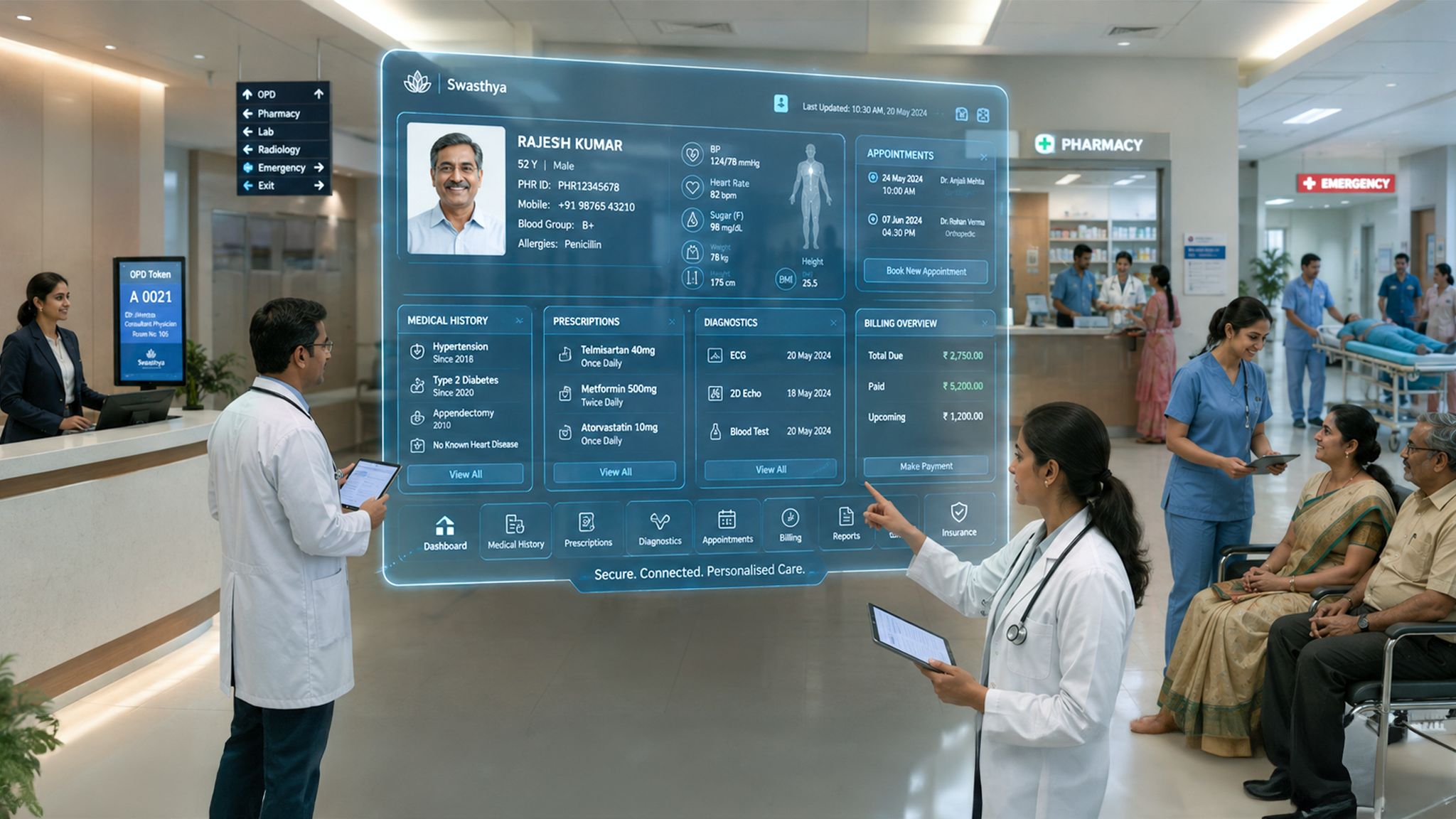
One of the most powerful capabilities of a connected healthcare platform is the ability to maintain a longitudinal view of the patient. A patient’s story should not disappear when an outpatient encounter is completed. It should not become fragmented when the same patient moves from OPD to emergency, from emergency to inpatient care, from ward to ICU, from diagnostics to surgery, and eventually from hospital discharge to follow-up. The treating team should be able to access relevant information across the episode of care, including: clinical history, allergies, diagnoses, medications, investigations, radiology findings, procedures, nursing observations, care plans, previous admissions, discharge information, and other clinically relevant documentation. This longitudinal clinical context is essential for continuity of care, safer decision-making, medication reconciliation, reduction of duplication, and better care coordination.
Why We Built Lifetrenz Around the Patient Journey
Our contribution to the healthcare ecosystem is through our flagship platform, Lifetrenz—a connected HIS + EHR + RCM platform for large hospitals and hospital chains.
The philosophy behind Lifetrenz is simple, but fundamental: The patient journey must remain at the centre of the healthcare enterprise. Every workflow ultimately connects back to the patient.
Registration creates the identity.
Appointments initiate access to care.
Clinical documentation captures the patient’s medical story.
Orders trigger diagnostic and therapeutic workflows.
Nursing ensures continuity at the bedside.
Pharmacy contributes to medication safety.
Laboratory and radiology generate diagnostic evidence.
Operating theatre and critical care workflows manage high-risk episodes.
Insurance and revenue-cycle processes enable financial continuity.
Quality teams monitor outcomes and compliance.
Management requires operational and financial intelligence to govern the organisation effectively.
These functions should not operate as disconnected islands. They must function as parts of an integrated healthcare delivery ecosystem. Lifetrenz is designed with this connected philosophy—bringing together clinical, administrative, operational, financial, and revenue-cycle workflows so that information can follow the patient across the continuum of care.
From Transaction Processing to Intelligent Healthcare Operations
Traditional hospital software was largely designed to record transactions. Modern healthcare platforms must go considerably further. Healthcare organisations increasingly require systems capable of providing real-time operational visibility, clinical context, actionable alerts, workflow orchestration, management dashboards, quality indicators, revenue intelligence, and decision support. A connected digital platform should help healthcare organisations understand:
- What has happened?
- What is happening now?
- What is pending?
- Who is responsible?
- What requires immediate attention?
- Where is there a potential clinical, operational, or revenue gap?
- What can be anticipated before it becomes a problem?
This transition from simple data capture to actionable healthcare intelligence will define the next generation of hospital information systems.
What a Connected Healthcare Enterprise Should Enable
The objective of an integrated platform such as Lifetrenz is to support healthcare organisations in achieving:
- Continuity of care across the complete patient journey.
- Interdepartmental clinical coordination and structured handoffs.
- A longitudinal patient record available to authorised caregivers.
- Real-time clinical and operational visibility.
- Better visibility of pending orders, activities, approvals, and interventions.
- Closed-loop workflows between ordering, execution, result generation, acknowledgement, and follow-up.
- Improved medication-management and patient-safety processes.
- Better utilisation of beds, operating theatres, equipment, manpower, and other resources.
- Stronger insurance, billing, and revenue-cycle controls.
- Reduced process leakage and unnecessary duplication.
- Support for clinical governance, accreditation, audit, quality management, and regulatory compliance.
- Management-level dashboards and enterprise-wide visibility and control.
- Better data availability for analytics and informed decision-making.
- A more transparent, coordinated, and reassuring patient experience.
Ultimately, technology should help an organisation move from a reactive model of hospital management toward a more proactive, data-driven, and clinically aware operating model.
Interoperability Will Define the Connected Hospital
No healthcare platform can operate in complete isolation. Modern hospitals interact with diagnostic devices, laboratory analysers, PACS/RIS platforms, pharmacy systems, medical equipment, insurance portals, government health platforms, patient applications, external laboratories, health-information exchanges, and increasingly AI-enabled systems. This makes interoperability essential. Standards such as HL7 and FHIR, structured APIs, terminology standards, and secure health-information exchange mechanisms are becoming fundamental to creating a digital health ecosystem where information can move securely and meaningfully between systems. Connectivity is therefore no longer simply about connecting hospital departments. It is about creating a connected healthcare ecosystem around the patient.
Artificial Intelligence Will Increase the Value of Connected Data
Artificial intelligence will increasingly support clinical and operational decision-making. But AI is only as useful as the quality, completeness, context, and timeliness of the data available to it. Fragmented information produces fragmented intelligence. A connected EHR and hospital platform creates the foundation upon which future capabilities can evolve such as clinical decision support, predictive analytics, deterioration alerts, resource forecasting, revenue leakage identification, personalised patient engagement, and intelligent workflow prioritisation. The future is therefore not simply AI-enabled healthcare. It is connected, interoperable, data-driven healthcare augmented by responsible AI.
The Future Hospital Must Be Connected
Healthcare will continue to become more specialised. Diagnostics will become more sophisticated. Treatment protocols will become increasingly personalised. Hospital networks will become larger and geographically distributed. Patients will demand transparency, mobility, digital engagement, and access to their own health information. Clinicians will face ever-growing volumes of clinical data. Healthcare leadership will demand real-time visibility into quality, operations, finance, and outcomes. Therefore, one of the greatest challenges of the next generation of healthcare will not be the ability to generate more data. It will be the ability to ensure that:
“the right information reaches the right authorised person, at the right point in the patient’s journey, within the right clinical or operational context, so that the right action can follow.” That is the real value of connectivity.
A connected healthcare organisation should be capable of understanding what has already happened, identifying what is currently happening, recognising what remains pending, highlighting what requires intervention, and supporting the care team before a gap becomes an adverse event or an operational failure.
This is where technology can make its most meaningful contribution. Not by replacing the physician. Not by replacing the nurse. Not by replacing clinical judgement. And certainly not by removing the human dimension from healthcare. Rather, by connecting the caregivers, coordinating the workflows, presenting the relevant information, strengthening governance, and helping healthcare professionals focus their attention where it matters most.
Because behind every UHID, encounter number, diagnostic order, medication order, insurance authorisation, surgical procedure, invoice, and discharge summary is not merely a record in a database. There is a person. And beside that person is often a family placing enormous trust in the healthcare system. At Lifetrenz, we believe that the patient journey must remain the centre of gravity of the healthcare enterprise.
Connect the workflow. Empower the caregiver. Anticipate the gap. Strengthen governance. Protect the patient journey.