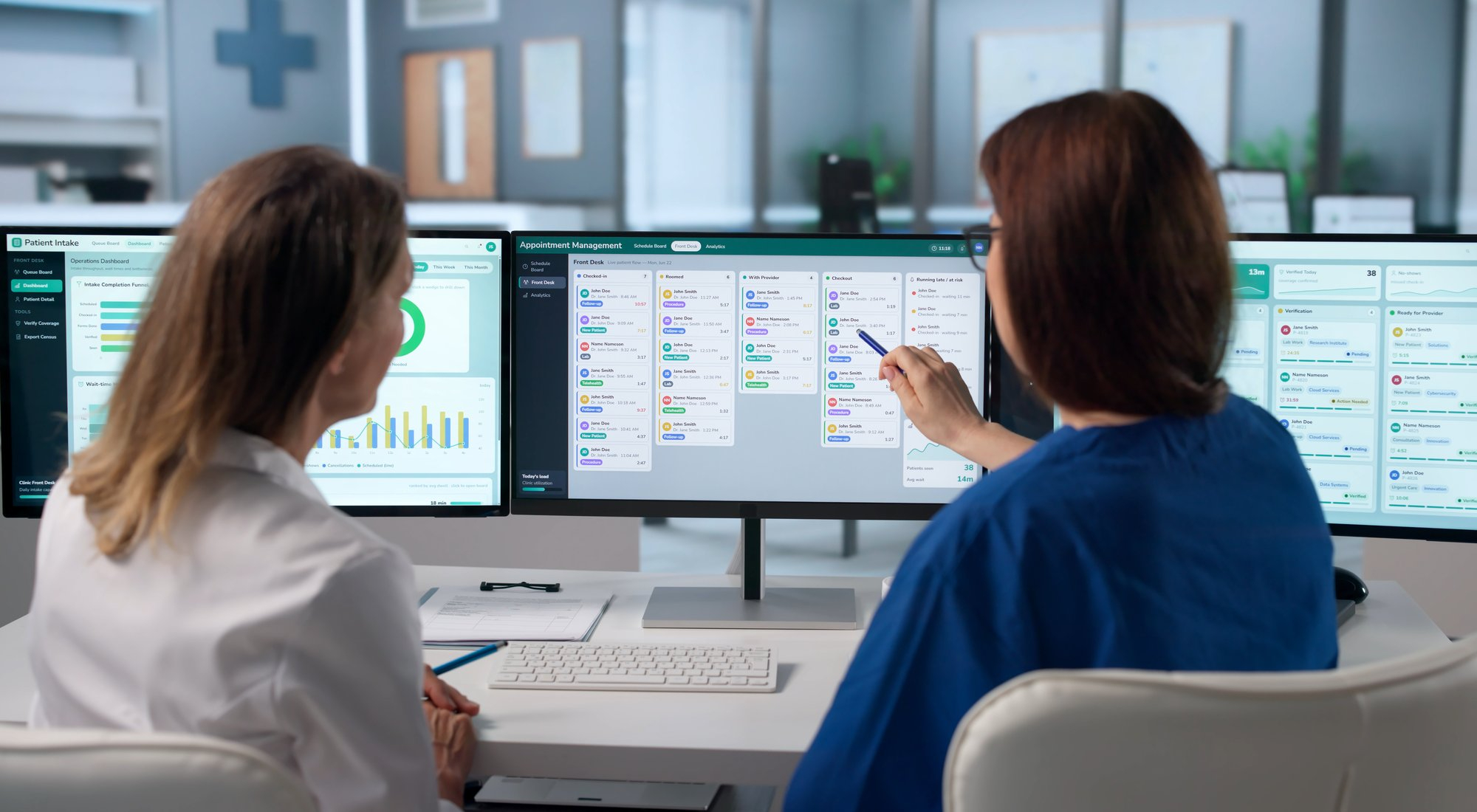
Walk into almost any hospital today and you’ll find screens everywhere. Electronic health records, digital lab systems, online scheduling portals, pharmacy software, billing platforms. By every measure, healthcare has gone digital.
And yet, a significant number of patients still fill out the same paper forms three times. Doctors still chase test results down hallways. Nurses still spend more than half their shift on data entry. And billing departments still send invoices patients don’t recognize for services they barely remember receiving.
The uncomfortable truth is that healthcare hasn’t had a digitization problem for a long time. What it has — and what it’s only beginning to solve — is a connection problem.
The Hidden Cost of Fragmentation
Here’s a number worth sitting with: administrative costs now account for more than 40% of total expenses hospitals incur in delivering care to patients, according to data from Strata Decision Technology cited in a 2024 American Hospital Association report.
And the burden is not small. Physicians spend an average of 15.6 hours per week on administrative duties — nearly two full clinical days lost to non-clinical work. Studies consistently demonstrate that physicians spend twice as much time on electronic documentation and clerical tasks as compared to time providing direct patient care.
That’s not a productivity quirk. That’s a structural failure — one that flows directly from disconnected workflows.
Think about what happens when a patient moves from one department to another in a fragmented hospital environment. The outpatient team has one system. The lab uses another. The pharmacy runs on a third. Billing has its own platform entirely. When those systems don’t talk to each other, the gap between them gets filled the old-fashioned way: phone calls, manual data re-entry, printed summaries passed between floors, and staff who spend their day being human middleware.
A 2025 CAQH report found that U.S. healthcare avoided an estimated $258 billion in administrative costs in 2024 through electronic transactions and improved data exchange — but it also identified a remaining $21 billion savings opportunity through full automation of transactions that are still handled manually or only partially automated. That gap is what connected workflows are designed to close.
What Patients Actually Experience
Patients aren’t reading operational reports, but they feel the effects of fragmented workflows every single time they interact with a health system.
Consider something as routine as a specialist visit. A patient gets a referral from their General Practitioner (GP). They call the specialist’s office, wait on hold, and provide their demographic information again — even though it’s already in the GP’s system. They arrive for the appointment and fill out intake forms from scratch. The specialist can’t immediately see the GP’s notes or the latest blood work, so they order a duplicate test. The results take two days because they’re routed through a separate lab portal. The prescription is handwritten and sent to a pharmacy that doesn’t have a current medication history on file.
At no point did anyone do anything wrong. The failure wasn’t human error. It was the absence of a connected thread running through the entire encounter.
Compare that to what’s possible. In hospitals where digital workflows are fully integrated, registration details captured at booking flow automatically into clinical systems. Previous consultations appear before the clinician even walks into the room. Diagnostic requests are placed electronically and results returned the same way. Prescriptions hit the pharmacy queue immediately, with a full medication history attached. Follow-up appointments are scheduled before the patient reaches the exit.
One analysis found that clinics implementing doctor appointment scheduling software reduced patient wait times by 40%, with automated reminders further cutting no-shows and improving resource utilization. A simulation study in urgent care found that shaving just 2.5 minutes from a single administrative step in the history-taking process decreased average triage wait times by more than 26%. Saving five minutes cut wait times by nearly 55%.
Small changes in workflow design, in other words, have outsized effects on what patients actually experience.
The Registration Bottleneck: Where Friction Begins
For most patients, the journey starts before they ever walk through the door — with appointment booking and registration. And this is where many health systems still lose ground.
Traditional registration processes ask patients to provide the same information repeatedly across departments. In a connected workflow model, that data is captured once and flows automatically through every subsequent touchpoint. Front-desk staff shift from data collectors to care facilitators.
Modern scheduling platforms now allow patients to book slots, choose providers, receive automated reminders, and reschedule digitally — functions that reduce administrative call volumes and no-show rates simultaneously. When those scheduling systems are connected to broader patient management infrastructure, registration becomes the first link in a continuous chain rather than an isolated transaction repeated at every department.
The downstream benefit is significant. Every minute saved at registration frees a staff member to focus on something that actually requires human judgment.
Outpatient Care: Where Most Encounters Happen
It’s worth remembering that the majority of healthcare interactions take place in outpatient settings — clinics, day surgeries, specialist consultations, diagnostic centers. These environments handle enormous volumes of encounters every day, and without connected workflows, the friction compounds quickly.
Consider a cardiology clinic in a mid-sized hospital. Without integration, a cardiologist seeing a patient for a follow-up might spend the first several minutes of the appointment reconstructing a clinical picture from fragmented sources — calling up one system for labs, another for imaging reports, a third for medication history. The consultation time that exists for clinical decision-making gets consumed by administrative archaeology.
A connected outpatient management system changes that dynamic entirely. The clinician opens a single view: the appointment is confirmed, previous consultations are visible, diagnostics are attached, and the current medication list is populated and reconciled. The consultation becomes what it’s supposed to be — a conversation about care, not a data retrieval exercise.
What Happens in the Lab Gap
Diagnostics are a particularly revealing case study in what happens when integration breaks down.
In a traditional workflow, a physician orders a test. A requisition form is generated. It travels — sometimes physically — to the lab. Someone there enters it into the lab information system. The sample is collected, processed, and the result is generated. Then it travels back: via fax, email, or portal, to the ordering physician, who may or may not see it in time to act before the patient’s next encounter.
A study analyzing over 6,800 imaging exam requests found a significant reduction in waiting times after introducing standardized digital workflow automation, with fewer waiting days on average in 2022 compared to 2019.
In a connected environment, the lab order is placed electronically, acknowledged in real time, and the result is returned directly to the clinician’s workflow the moment it’s available. No phone calls. No faxes. No lost results. No delays that cost patients time — or in acute cases, outcomes.
Pharmacy: The Quiet Risk in Disconnected Systems
Medication errors are among the most persistent and preventable causes of patient harm in healthcare. And a significant number of them trace back to the same root cause: prescription information that doesn’t travel cleanly from the prescribing clinician to the dispensing pharmacist.
In facilities where prescribing and pharmacy systems are integrated, electronic prescriptions are generated at the point of care with a complete medication history already attached. Pharmacists can verify availability, flag potential interactions, and update inventory in the same workflow. Care teams maintain real-time visibility into what’s been dispensed and when.
Hospitals that transitioned from paper-based records to electronic health records reported a 60% reduction in medication administration errors, with staff gaining instant access to patient histories.
That figure — 60% — reflects what happens when information that already existed in a system is made available to the people who need it, at the moment they need it, without relying on a manual handoff that can fail.
Inpatient Complexity: Synchronizing More Moving Parts
Hospital admissions introduce a coordination challenge that outpatient care doesn’t face in the same way. A single admitted patient might interact with nursing teams, attending physicians, consultants from multiple specialties, pharmacists, physiotherapists, diagnostic technicians, and administrative staff — all in the course of a single day.
Without a connected inpatient management system, coordination happens through a patchwork of verbal handoffs, paper notes, and parallel documentation in separate systems. The risk isn’t just inefficiency. It’s that critical information gets lost in the gaps between departments.
In a connected environment, bed allocation, nursing documentation, physician orders, medication administration, and discharge planning are all part of the same operational fabric. A change made by one team is visible to every other team immediately. A physician ordering a medication at 9 AM doesn’t need to verbally communicate that to the ward pharmacist at 11 AM — the system already has.
The Documentation Trap
One of the more quietly damaging consequences of poor workflow design is what it does to clinical documentation.
Research suggests physicians spend approximately half their workday working in EHRs, with many completing documentation during non-work hours — spending an average of 90 minutes daily on EHR tasks outside clinic hours.
This isn’t just a quality-of-life issue for clinicians, though it is certainly that. High administrative multitasking has been linked with diagnostic inaccuracies and reduced professional satisfaction, and clinicians facing burnout are more likely to report medical errors, lower patient satisfaction, and intentions to leave the profession altogether.
Connected workflows don’t eliminate documentation — they make it less repetitive. When a longitudinal patient record is maintained across encounters, clinicians are building on existing information rather than recreating it from scratch at every visit. Prior diagnoses, allergies, medications, lab trends, and imaging history are already there. The clinician’s job becomes updating and interpreting, not transcribing.
That shift has real implications for care quality, not just operational efficiency.
Billing: The Part That Touches Every Department
Billing is often treated as an afterthought in discussions about patient experience. It shouldn’t be. A confusing or delayed invoice is frequently the last interaction a patient has with a health system — and it shapes how they remember the entire encounter.
Billing failures in disconnected hospitals are almost always workflow failures. When diagnostic charges, pharmacy dispensing, procedure codes, and consultation fees are managed in separate systems, the charge capture process is only as good as the manual reconciliation that happens afterward. Missed charges, duplicate entries, and delayed invoices are predictable outputs of a system where financial workflows aren’t connected to clinical ones.
When those connections are in place, every service generates a charge automatically in real time. Billing teams work from complete, accurate data. Patients receive invoices that reflect what actually happened — and receive them in a reasonable timeframe.
McKinsey estimates hospitals and health systems spend approximately $40 billion annually on billing and collections alone. A meaningful portion of that cost exists to manage the errors and gaps that connected workflows would prevent.
Discharge and What Happens After
Discharge planning is one of those processes that healthcare systems universally acknowledge should start early — and that often doesn’t, because the information needed to plan it is scattered across departments that aren’t sharing data in real time.
In a connected model, discharge planning begins at admission. As the clinical picture develops, discharge summaries are being built, follow-up appointments are being identified, medication instructions are being prepared, and referrals are being initiated — not on the day of discharge, but in parallel with care delivery. When the patient is ready to leave, the administrative machinery is already done.
The benefits extend beyond the hospital. Care continuity after discharge — follow-up appointments, home healthcare coordination, remote monitoring, medication adherence — depends on the same information being available to the right people at the right time. Without connected workflows, post-discharge care becomes a fresh start rather than a continuation.
Leading healthcare organizations in 2025 are increasingly defining interoperability success not by compliance metrics, but by how well information improves care coordination, transitions, patient safety, and patient experience. Discharge planning and post-acute care are where that shift shows up most clearly in patient outcomes.
The Operational Intelligence Dividend
There’s a downstream benefit to connected workflows that often goes underappreciated: the data they generate.
When clinical, operational, and financial processes are running through integrated systems, those systems produce a continuous stream of operational intelligence. Bed occupancy trends become visible. Diagnostic turnaround times can be monitored and improved. Pharmacy utilization patterns emerge. Consultation volumes by department, by hour, by day — all of it becomes available for leadership to act on.
AI adoption in clinical settings is accelerating rapidly — in 2023, 38% of U.S. physicians reported using AI in their practice, rising to 66% by 2024. But AI tools are only as good as the data they’re trained on and given access to. A health system with fragmented workflows and siloed data can deploy AI models, but those models will be working with an incomplete picture. Connected workflows are the precondition for AI to be genuinely useful in clinical and operational settings.
The global AI in healthcare market reached $26.7 billion in 2024, and the investments flowing into the sector reflect a real appetite for intelligent, automated decision support. What the investment landscape sometimes underweights is that the facilities best positioned to benefit from those tools are the ones that have already done the less glamorous work of connecting their underlying workflows.
What Good Implementation Actually Looks Like
Deploying workflow software and transforming workflows are two different things. Organizations that have achieved real results tend to share a few common characteristics.
They redesign processes before they digitize them. Digitizing a broken workflow produces a faster broken workflow. The most effective implementations begin by mapping current-state processes, identifying where handoffs fail, and redesigning the process itself before selecting the technology to support it.
They invest in change management alongside technology. A scheduling system that clinicians work around is worth less than the one it replaced. Adoption rates and workflow adherence matter as much as feature sets.
They build for interoperability across departments and vendors — not just within a single system. About 75% of hospitals participate in health information exchanges, but only 35% participate in both HIEs and national networks, meaning meaningful data sharing remains inconsistent at scale.
And they treat implementation as an ongoing process, not a project with an end date. Workflows evolve. Patient needs change. Technology improves. The organizations that sustain gains over time are the ones that continue optimizing rather than treating go-live as the finish line.
The Bigger Picture
There’s a version of this conversation that frames digital workflow transformation as an efficiency initiative — something that reduces costs, speeds up processes, and improves throughput. That framing isn’t wrong, but it’s incomplete.
When a patient arrives at a hospital with chest pain and every department has access to the same clinical picture in real time, that’s not an efficiency gain. That’s a safety outcome. When a nurse doesn’t have to manually transcribe a physician’s order because the system handles it automatically, the time saved is real — but so is the error that didn’t happen. When a patient with a chronic condition has a care team that can see their full history across every encounter, the continuity that results isn’t a feature. It’s medicine.
Connected digital workflows are, at their best, an expression of something that healthcare has always valued: treating the whole patient, not just the department they happen to be standing in. The technology is the infrastructure. The goal is the same as it’s always been.
The hospitals and health systems that are getting this right aren’t just more efficient. They’re closer to the care experience that patients deserve — and that clinicians, given the right tools, are more than capable of delivering.
Solutions like Lifetrenz are helping healthcare organizations bring clinical, operational, and financial workflows together into a single connected ecosystem — from the first appointment booking through discharge, post-acute care, and beyond.