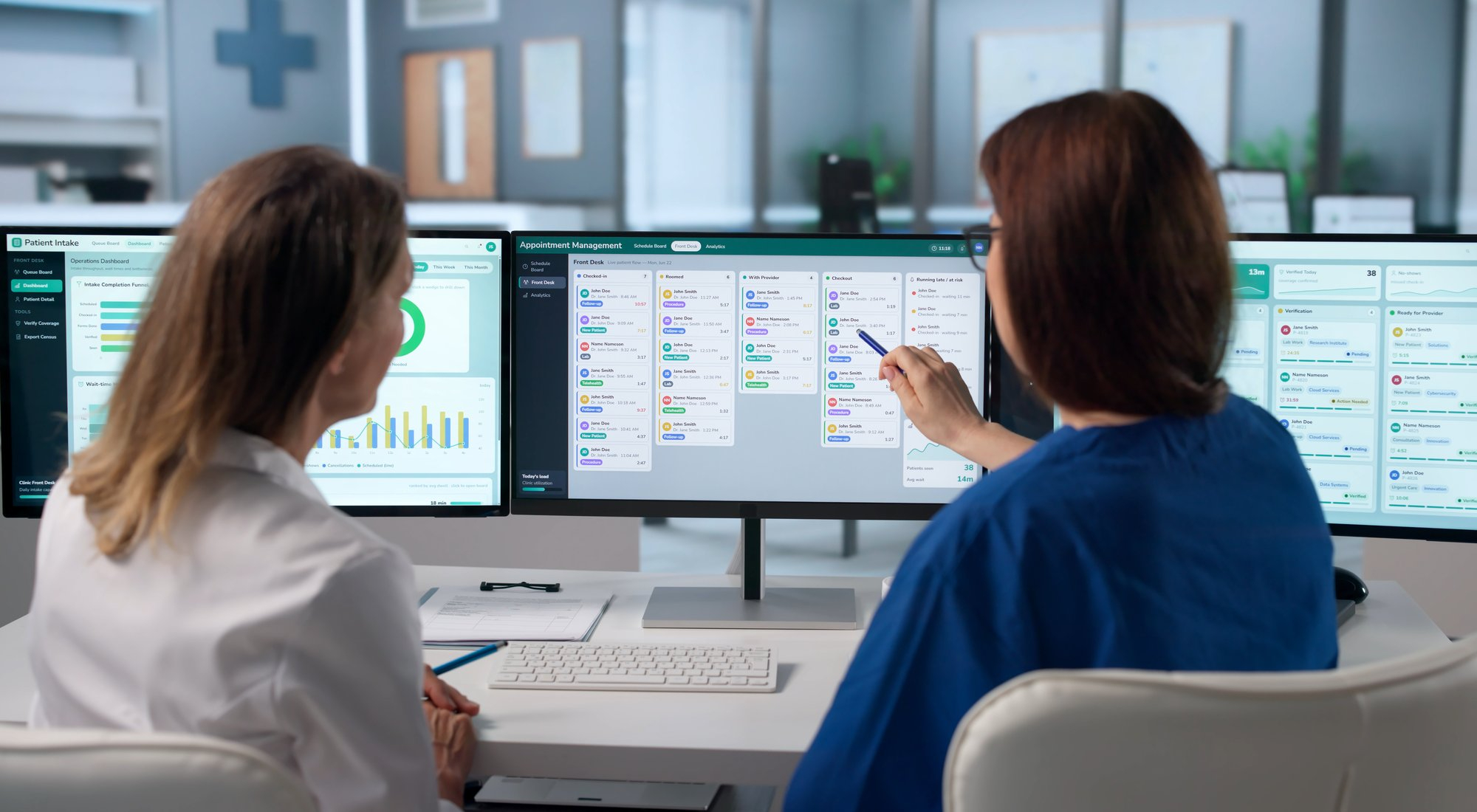
Ten years ago, if you had walked into most Indian hospitals, you’d see the same scene repeating itself: a records clerk flipping through a rack of paper files, a nurse waiting for a runner to bring lab results from two floors down, a billing desk cross-checking a patient’s insurance details by phone. Walk into a growing number of Indian hospitals today, and that scene has quietly disappeared.
In March 2026, Telangana opened TIMS Sanathnagar as a fully digitized hospital running on an integrated electronic Hospital Management Information System — covering everything from appointment scheduling to pharmacy and lab integration, live from day one. A month later, Apollo Hospitals opened its 76th facility, a 400-bed unit built as a smart hospital from the ground up. These aren’t pilot projects anymore. They’re what “new hospital” is starting to mean in India.
This shift didn’t happen because hospitals suddenly fell in love with software. It happened because the old way was visibly, measurably costing them — in time, in errors, and in money that never made it to collections. Hospital information systems address that gap in a fairly unglamorous but very concrete way: they connect the dots between departments that used to operate as islands.
The efficiency problem was never really about technology
It’s tempting to frame hospital digitization as a tech upgrade story. It’s really an operations story. A patient management system exists to solve a specific, boring problem: making sure that a person’s information — history, allergies, current medications, ongoing treatment — travels with them as fast as they move through the building. Without it, that information travels at the speed of a human being carrying paper, which in a 400-bed hospital with a dozen departments is not fast at all.
The global numbers back up how central this has become to hospital strategy. The hospital information system market is projected to grow at a compound rate north of 9% through the early 2030s, and industry analysts consistently flag laboratory information systems as one of the fastest-growing pieces of that market — largely because diagnostic testing volumes have exploded and hospitals can no longer manage that volume on spreadsheets and printed reports. India, alongside China, is repeatedly named as one of the markets accelerating this shift fastest, driven in large part by the Ayushman Bharat Digital Mission, which has already linked over 100 crore health records nationally as of mid-2026, up from 50 crore just fifteen months earlier.
Where a hospital patient management system actually changes the day
The easiest way to see the value of a hospital patient management system is to follow one patient through a bad day and a good day.
On a bad day: a patient arrives at the emergency desk, gives their history verbally because nobody can locate their previous file, gets sent for a blood test, and then everyone waits — the doctor, the nurse, the patient — for a lab technician to walk a printed report back to the ward. If that patient needs to be referred to a specialist in another department, their notes get summarized again, by hand, introducing another chance for something to be missed or transcribed wrong.
On a good day, in a hospital running a connected system, that same patient’s ABHA-linked record pulls up their history automatically at registration. The blood test result posts directly to their chart the moment it’s verified, visible to every clinician who needs it, no runner required. The referral note doesn’t get rewritten — it’s the same record, viewed by a different department. This is the entire point of digitization: not adding a screen to every desk, but removing the manual handoffs where information used to get lost, delayed, or duplicated.
Two systems that rarely get the credit they deserve
Two pieces of hospital IT infrastructure tend to be underrated in conversations about digital transformation, mostly because they’re not patient-facing — but hospital administrators will tell you they’re where a lot of the real financial pain lives.
The first is inventory. A hospital inventory system sounds like a back-office concern, but stock-outs of a critical drug or a delay in reordering surgical consumables can shut down a procedure or send a patient elsewhere. On the flip side, over-ordering ties up working capital that a hospital, especially a mid-sized one, genuinely cannot spare. A properly integrated hospital inventory system links consumption data from wards and operation theatres directly to procurement, so reordering happens against actual usage patterns instead of a monthly guess. That single change — turning inventory from a periodic manual audit into a live, connected number — is one of the more immediate ROI wins hospitals report after digitization, because the savings show up in working capital almost as soon as the system goes live.
The second is diagnostics. A laboratory information system does for the lab what the patient record does for the ward — it removes the paper and the phone calls from a process that used to depend on both. Given that laboratory information systems are cited as commanding roughly 42% of the broader healthcare IT applications market, and are expected to keep growing as diagnostic volumes rise, it’s clear that labs have become one of the busiest, most error-prone parts of hospital operations if left unconnected. A laboratory information system that talks directly to the patient record eliminates a whole category of mistakes — wrong sample labels, delayed result delivery, results that never make it into the main chart at all.
The financial case is just as real as the clinical one
None of this stays confined to clinical quality. Claim denial rates for hospitals have been climbing, with several 2025 industry surveys putting initial denial rates in the 12–15% range, up from around 10% just a couple of years earlier — and a large share of those denials trace back to exactly the kind of documentation and eligibility errors a connected system is built to catch before submission. For an Indian hospital processing several crore in monthly claims, even a modest reduction in denials is real, recurring cash flow, not an abstract efficiency metric.
Where this leaves hospital leadership
The hospitals opening today — TIMS Sanathnagar, Apollo’s newest smart facility, and the growing list of ABDM-integrated institutions behind them — aren’t digitizing because it’s fashionable. They’re doing it because the alternative is running a modern hospital on infrastructure that can’t keep pace with patient volumes, payer scrutiny, or government reporting requirements.
A connected platform that brings the patient management system, hospital inventory system, and laboratory information system onto one foundation isn’t really an IT decision anymore. It’s an operational one — the kind that shows up in shorter waits, fewer errors, and a healthier bottom line, all at once.
This is the exact problem Lifetrenz was built around. Rather than stitching together separate modules for registration, inventory, diagnostics, and billing, Lifetrenz brings care delivery, hospital operations, and revenue cycle management onto a single AI-enabled platform — so a hospital isn’t left reconciling four different systems that were never designed to talk to each other. For hospitals and clinics across India and the UAE working through exactly this kind of transition, that single foundation is what turns digitization from a scattered set of upgrades into one connected operation.