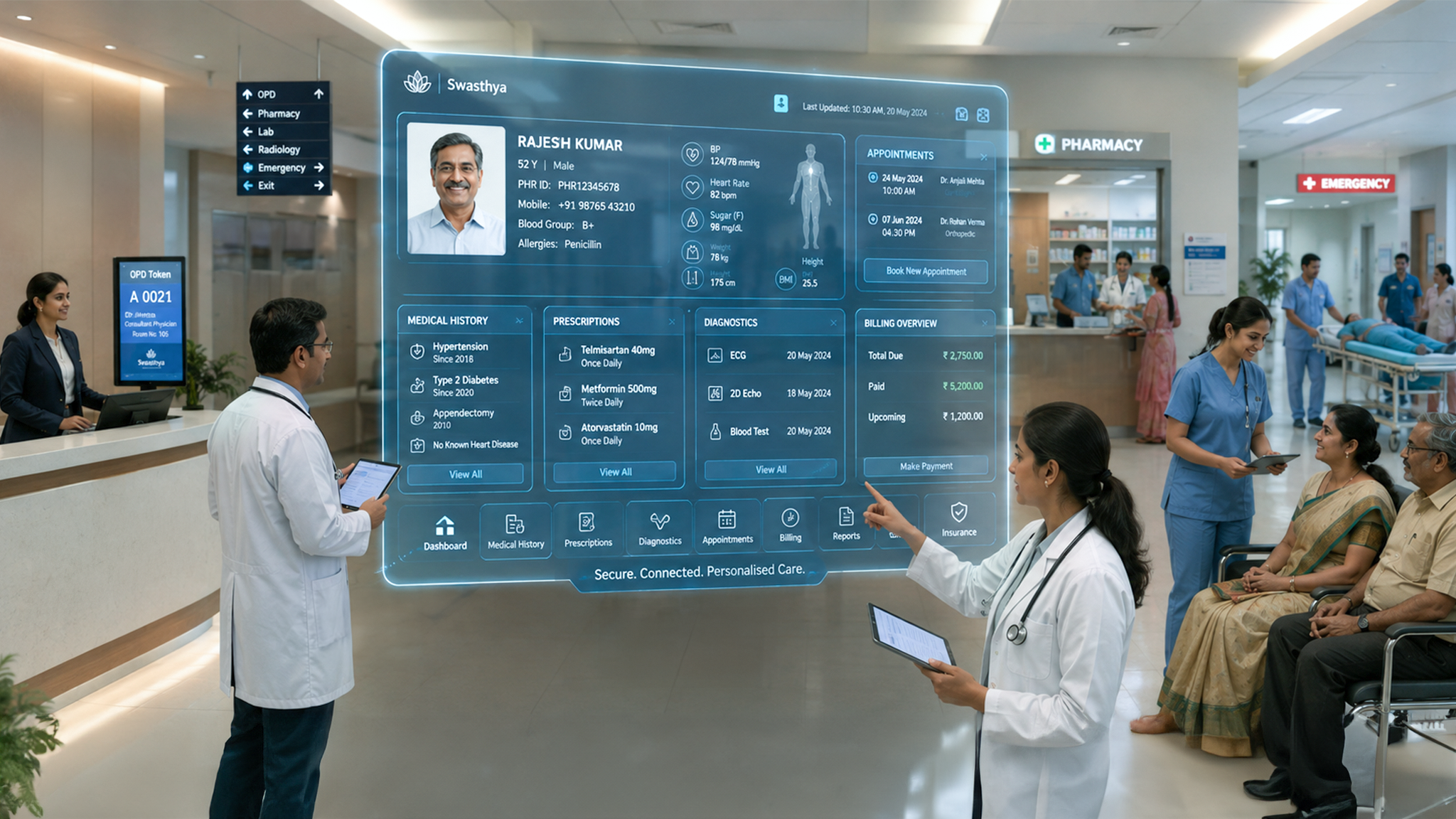
A patient visits a hospital for a consultation. The hospital registers the patient, records the doctor’s findings, generates a prescription, and later adds diagnostic reports to the patient’s medical file.
All of this happens within the hospital’s Hospital Information System (HIS).
But what happens when the same patient visits another hospital a few months later? Can the second hospital access the patient’s previous prescription or diagnostic report without asking them to carry physical copies?
This is one of the problems the Ayushman Bharat Digital Mission (ABDM) aims to address.
ABDM is designed to connect patients, healthcare providers and digital health applications through a common, interoperable framework. It uses the Ayushman Bharat Health Account (ABHA) for patient identification, standardised health records for information exchange, and a consent mechanism that allows patients to control how their health information is shared.
For hospitals, this means their HIS needs to do more than maintain internal patient records. It must also be able to communicate with the ABDM ecosystem.
And this is where integration becomes important. It connects the hospital’s everyday workflows, from registration to discharge, with a wider digital health network.
Let’s look at how this works in practice.
The Difference Between ABHA, ABDM and UHI
These three terms are often used together, but they serve different purposes.
| Component | What it does |
| ABDM | The national digital health ecosystem that enables interoperability between patients, healthcare providers and digital health applications. |
| ABHA | Ayushman Bharat Health Account. It provides a unique 14-digit health identifier for linking an individual’s health records across participating providers. |
| ABHA Address | A user-friendly address associated with the individual’s HIE-CM, used in health information exchange and consent workflows. |
| UHI | Unified Health Interface. An open network that enables patients to discover and access healthcare services across different digital platforms. |
Think of it this way: ABHA helps identify the patient, ABDM provides the framework for exchanging health information, and UHI helps connect patients with healthcare services.
An important distinction: UHI is not another health record repository. It is the service interoperability layer of ABDM. Its purpose is to connect service seekers and providers across different applications.
UHI was officially launched on 29 June 2026. The Ministry of Health and Family Welfare describes it as an open network that allows patients and providers to connect without depending on a single application.
How Does a Hospital’s HIS Connect to ABDM?
The hospital’s hospital software remains the primary system where its day-to-day clinical and administrative activities take place.
Patient registration, OPD consultations, IPD admissions, laboratory investigations, prescriptions, billing and discharge documentation continue to happen within the HIS.
ABDM integration adds the ability to connect these activities to the national digital health ecosystem.
The National Health Authority (NHA) provides the digital building blocks and APIs that an ABDM-compliant HIS must integrate with. The HIS uses these interfaces to perform functions such as ABHA verification, linking health records, responding to consent requests and exchanging information.
A hospital generally participates in two important roles:
- Health Information Provider (HIP): The hospital generates and maintains health records and makes them available for sharing through ABDM, subject to the prescribed consent framework.
- Health Information User (HIU): The hospital requests and accesses health records generated by other providers, after obtaining the patient’s consent.
A hospital can perform both roles. For example, it acts as a HIP when sharing its own diagnostic reports and as an HIU when requesting a patient’s previous reports from another hospital.
This distinction is important because integration involves both sending and receiving health information.
The Actual Workflow: From Patient Registration to Health Record Exchange
Let’s follow a patient through a typical hospital visit to understand what happens behind the scenes.
1. Patient Identification: The HIS Connects with ABHA
The process begins at registration.
When a patient arrives, the registration team checks whether they already have an ABHA number or ABHA Address.
If the patient has one, the HIS can use the ABDM-integrated APIs to capture and verify the patient’s identity. The ABHA details can then be linked to the hospital’s existing patient registration or Medical Record Number (MRN).
If the patient does not have an ABHA, the hospital can assist with its creation through the approved process, provided the patient wishes to enrol.
There are two important things to understand here:
- ABHA is not a replacement for the hospital’s internal patient ID. The hospital can continue using its own MRN for internal identification.
- Creating or sharing an ABHA is voluntary. A patient who does not wish to provide one must still be able to proceed with the hospital’s normal registration and care process.
In practical terms, the HIS maintains the hospital’s patient record while associating it with the patient’s verified ABHA identity for interoperability.
This helps connect records generated at different healthcare facilities to the same individual, subject to correct identity matching and record linking.
2. Health Record Creation: The HIS Becomes a Health Information Provider
Once the patient is registered, the usual clinical workflow continues.
The doctor records the consultation findings. The laboratory generates investigation reports. The pharmacy processes prescriptions. At discharge, the hospital prepares a discharge summary.
These records are stored in the hospital’s HIS.
With ABDM integration, the HIS must also support the creation and sharing of health records in the prescribed interoperable formats.
This is where FHIR (Fast Healthcare Interoperability Resources) comes in.
FHIR is a healthcare data exchange standard that allows different health information systems to understand and exchange information using a common structure.
ABDM uses FHIR R4 resource bundles, profiled for the Indian healthcare context in collaboration with the National Resource Centre for EHR Standards (NRCeS).
The ABDM health information exchange specifications cover several document types, including:
- OPD consultation notes
- Diagnostic reports, including pathology and radiology reports
- Prescriptions
- Discharge summaries
- Immunisation records
- Wellness records
For example, a laboratory report generated in the HIS should be structured according to the applicable ABDM specifications before it is shared through the network.
The format can include structured clinical information and attachments such as PDFs or images. However, full-resolution DICOM imaging studies are not included in the current document specifications described in the HIP/HIU guidelines. The report and relevant supporting images can be shared within the supported formats.
The important point is that simply storing a report as a PDF in the HIS does not automatically make it interoperable. The healthcare software must support the applicable data structures and exchange requirements.
3. Linking Records: The Role of HIE-CM
This is where the hospital’s HIS starts communicating with the Health Information Exchange and Consent Manager (HIE-CM).
Suppose the patient has completed an OPD consultation and received a prescription.
The hospital’s HIS, acting as a HIP, creates a care context for that encounter. A care context is essentially a reference to a particular healthcare interaction. It can contain multiple related records, such as consultation notes, prescriptions and diagnostic reports.
The HIS then initiates the linking process through the ABDM network using the patient’s verified ABHA Address.
The HIE-CM maintains the links between the patient’s ABHA Address and the healthcare providers holding their records.
Once the linking process is completed, the patient receives a notification that a new health record is available. They can access it through a compatible Personal Health Record (PHR) application.
One important architectural detail: ABDM does not function as a central database that stores every hospital’s clinical records. The records remain with the respective Health Information Providers. The HIE-CM manages the consent and linking mechanisms, while the exchange gateway routes the interactions between participating systems.
This distinction matters to hospital leaders because the HIS remains responsible for maintaining and making its own records available through the prescribed framework.
4. Retrieving Records: How Another Hospital’s HIS Gets Access
Now, let’s look at the reverse process.
A patient visits Hospital B after previously receiving treatment at Hospital A. The doctor at Hospital B wants to review the patient’s earlier diagnostic reports and prescriptions.
If Hospital B’s HIS is integrated as an HIU, it can initiate a request for the patient’s health information.
The process broadly works as follows:
- The hospital identifies the patient using their ABHA details.
- The HIS initiates a request for relevant health records through the ABDM exchange framework.
- A consent request is sent to the patient through the associated HIE-CM and compatible PHR application.
- The patient reviews the request, including the purpose, information requested and validity period, and decides whether to approve it.
- Once consent is granted, the HIU can retrieve the permitted records from the respective HIPs.
- The hospital’s HIS receives the records and makes them available to authorised healthcare professionals.
For example, a patient may allow Hospital B to access their previous laboratory reports and discharge summary from Hospital A for a defined period.
The doctor at Hospital B can then review this information as part of the consultation rather than depending entirely on the patient’s physical documents.
Consent is not a one-time blanket permission. Each consent artefact specifies the purpose, information, recipient and duration of access. Patients can also revoke consent. The HIU must handle the received information according to the conditions specified in that consent.
Where Does UHI Fit into This Workflow?
So far, we have looked at how a hospital’s HIS exchanges health records through ABDM.
UHI addresses another part of the patient journey: finding and accessing healthcare services.
Consider a patient looking for a specialist consultation. They may use one digital application to search for a doctor, while the doctor or hospital uses a completely different hospital management system to manage appointments.
Without interoperability, both sides may need to use the same platform to connect.
UHI is designed to remove this dependency.
It uses open protocols and a common gateway maintained by NHA to connect service-seeking applications with verified healthcare providers.
Here’s how a typical interaction can work:
- The patient searches for a service: A patient uses a UHI-enabled application to find a doctor, hospital or available healthcare service.
- The request reaches the UHI gateway: The application sends the request through the network using the applicable open protocols.
- The network identifies eligible providers: Registered and verified healthcare providers can receive relevant service requests.
- The provider responds: The hospital or healthcare provider’s integrated system can respond to the request and support the relevant booking or service workflow.
- The patient completes the interaction: The patient can proceed with the service without necessarily using the hospital’s own application.
ABHA, HPR and HFR support the wider ecosystem by providing patient identification and verified professional and facility information.
For a hospital, this opens up a way to become discoverable and accessible through multiple compatible digital platforms rather than relying entirely on its own website or mobile application.
UHI and the ABDM health information exchange serve complementary purposes. UHI connects healthcare services, while HIE-CM facilitates consent-based exchange of health records. One does not replace the other.
What Does a Hospital Need Before Implementing ABDM Integration?
For hospital leadership, ABDM integration is not simply a software upgrade. It involves the hospital’s technology, registration processes, clinical documentation and information governance.
Here are the key areas to consider.
1. An ABDM-compliant HIS
The hospital’s existing HIS must support the required ABDM APIs, workflows and integration milestones. Hospitals using custom-developed systems must also ensure that their software undergoes the required integration and certification process.
2. Registration and patient identity management
The registration team should understand how to capture and verify ABHA details, handle existing patient IDs and assist patients who want to create an ABHA. Staff should also know how to proceed when a patient does not wish to participate.
3. Standardised clinical documentation
The hospital must ensure that its HIS can generate supported clinical documents in the required FHIR R4-based formats and maintain accurate patient and encounter associations.
4. Consent and access management
The hospital needs defined workflows for requesting, receiving, tracking and respecting patient consent. Access to retrieved records must be limited to authorised users and the permitted purpose.
5. Professional and facility registration
Healthcare facilities and professionals need to be appropriately registered and verified through the Health Facility Registry (HFR) and Healthcare Professionals Registry (HPR), as applicable.
6. Testing, security and certification
Integration must be tested in the ABDM Sandbox before production access. Applicable functional testing, security assessment and certification requirements must also be completed.
These are not activities that should be left entirely to the IT vendor. Hospital management, clinical leadership, registration teams and information security teams all have a role in implementation.
What Are the ABDM Integration Milestones for Hospitals?
The integration process is divided into milestones that help healthcare software progressively connect with ABDM.
The established HIP/HIU integration guidelines describe three core milestones:
| Milestone | What it covers |
| M1 | ABHA number creation, capture and verification. |
| M2 | Health Information Provider (HIP) capabilities, including linking and sharing digital health records. |
| M3 | Health Information User (HIU) capabilities, including accessing patient records with consent. |
A further development is relevant for hospitals implementing integration in 2026. The National Medical Commission’s March 2026 procedure for linking hospital HMIS with the ABDM-HMIS dashboard identifies M4 for the creation and verification of healthcare professionals and health facilities.
The same NMC procedure outlines the following implementation route:
- Register the software on the ABDM Sandbox Portal.
- Complete the applicable integration milestones.
- Undergo third-party functional testing.
- Complete a CERT-In empanelled Web Application Security Assessment (WASA).
- Demonstrate the integration before the NHA Integration Support Team.
- Obtain Health Tech Committee certification and final production go-live approval.
The NMC procedure also distinguishes between hospitals already using ABDM-enabled software, hospitals adopting new software and hospitals using non-ABDM-enabled or custom-developed systems.
Hospital leaders should confirm the applicable milestone and certification requirements with their HIS provider and NHA, rather than assuming that completing ABHA creation alone means the hospital is fully ABDM-integrated.
What This Means for Hospital Operations
The real value of ABDM integration is not just the ability to generate or link ABHA numbers.
It is the opportunity to make health information more accessible across the patient’s care journey.
For hospitals, this can support:
- Better continuity of care: Doctors can access relevant previous health records with the patient’s consent.
- Less dependence on physical documents: Patients can share digital prescriptions, reports and discharge summaries.
- More efficient registration: ABHA-based QR code workflows, including Scan and Share, can support faster OPD registration.
- Wider service discovery: UHI can help hospitals and healthcare professionals become accessible through multiple compatible applications.
- Improved interoperability: Standardised health records make it easier for different healthcare systems to exchange and interpret information.
The adoption numbers also show why this matters.
According to the Ministry of Health and Family Welfare, as of 17 September 2026, more than 97.61 crore ABHA IDs had been created and over 119.95 crore health records had been linked to ABHA. More than 5.78 lakh healthcare facilities and 11 lakh healthcare professionals were registered in the ecosystem.
The next challenge for hospitals is moving from registration and record-linking numbers to meaningful usage: making sure records are captured correctly, exchanged when needed and incorporated into everyday clinical workflows.
Conclusion
ABDM integration is changing how hospitals need to think about their information systems.
An HIS is no longer just a system for managing a hospital’s internal operations. It also needs to communicate with a wider healthcare ecosystem, identify patients consistently, share records in standardised formats and support consent-based access to information held by other providers.
ABHA, HIE-CM and UHI each play a different role in making this possible. Together, they create the foundation for a more connected healthcare experience.
For hospital leaders, the question is no longer just whether their HIS can create an ABHA number. It is whether the system can support the complete journey, from patient identification and record generation to secure information exchange and access to digital healthcare services.
At Lifetrenz, we believe connected healthcare begins with systems that work together. A hospital’s HIS should support its everyday clinical and operational needs while being ready to participate in India’s evolving interoperable digital health ecosystem.
Explore Lifetrenz Hospital Management Solutions to understand how connected clinical and operational workflows can support your hospital’s digital transformation.
References
1. National Health Authority (NHA). Guidelines for Health Information Providers, Health Repository Providers, Health Information Users and Personal Health Records Apps, 24 October 2022. Covers HIP/HIU roles, FHIR-based health information exchange, ABHA linking and consent workflows.
2. Press Information Bureau (PIB), Ministry of Health and Family Welfare. Union Health Minister Launches Unified Health Interface, 29 June 2026. Explains UHI architecture, interoperability principles and service discovery.
3. Press Information Bureau (PIB). Steps Taken for Cyber Security Under ABDM, 5 August 2025. Covers consent-based health data exchange, sandbox validation and security assessments.
4. National Health Authority (NHA). Office Memorandum on Adoption of ABDM-enabled HMIS by PM-JAY Empanelled Hospitals, 29 January 2026. Specifies the ABDM-enabled HMIS requirement for new PM-JAY hospital empanelments from 1 March 2026.
5. Press Information Bureau (PIB). Update on ABDM Progress, September 2026. Provides updated figures on ABHA creation, linked health records and registered facilities.
6. National Resource Centre for EHR Standards (NRCeS). ABDM Health Data Standards and Implementation Resources. Provides technical resources for FHIR-based health information exchange and Indian health data standards.